Why Feeling Stuck Isn't a Motivation Problem
Feeling stuck in your real estate career isn't a mindset failure. It's usually a structural problem — the wrong model, environment, or activity mix.
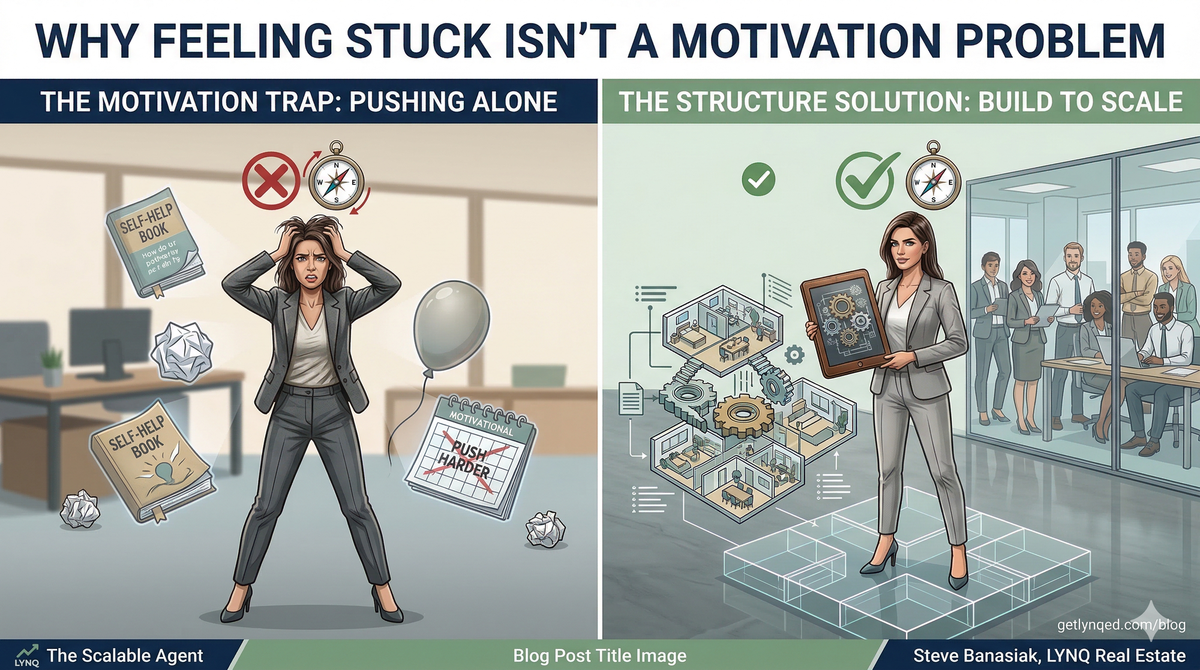
If you're a real estate agent on a team right now and something feels off — like you're doing the work, showing up, staying busy, and still not gaining any real ground — I want to offer you a different way to look at it.
Because the advice you've probably been given, if you've told anyone at all, is some version of "reconnect with your why" or "push harder" or "you just need to stay consistent." And I'm sure the people saying that mean well. But in most cases, that advice is the wrong diagnosis entirely.
Feeling stuck is not a motivational failure. It's not a sign that you're not cut out for this. It's not something you fix by reading another book or attending another rah-rah session. Most of the time, the stuck feeling is information. It's your instinct telling you that something about the structure around you — the model, the environment, or the activities filling your day — isn't aligned with what you're actually trying to build.
That distinction matters, because the solution for a motivation problem is completely different from the solution for a structural one. And if you keep treating a structural problem with motivational remedies, you'll burn through years of energy and still end up in the same place. This post is about learning to tell the difference — and what to do once you can see it clearly.
The Motivation Myth in Real Estate
Real estate has a motivation obsession. The industry is saturated with motivational speakers, hype events, morning routines, affirmation practices, and the persistent belief that if you're not producing, you're not believing hard enough. It's baked into the culture — from the big conferences to the team huddles.
And it works, briefly. You go to the event. You feel the energy. You come back fired up for three days, maybe a week. Then the fire dies, and you end up exactly where you started — except now you also feel guilty for not sustaining the energy. So you do it again. Rinse and repeat.
The reason motivation doesn't sustain progress is that it's an emotion, not a system. Emotions are temporary by design. They spike and they fade. Building a business on motivation is like building a house on a foundation that shifts every few days. It doesn't matter how good the house is — the foundation can't hold it.
What does sustain progress is structure — the right environment, the right model, and the right activities arranged in a way that produces results whether you feel motivated that morning or not. That's not an inspiring thing to hear. But it's the honest answer to why agents who seem less talented or less passionate sometimes outproduce agents who are more of both. The less passionate agent may simply be inside a better structure.
Think about the agents you know who are producing consistently. I'd wager most of them don't describe themselves as particularly motivated. What they describe is a routine — a rhythm they follow regardless of how they feel on any given Tuesday. They have a lead generation block that happens whether they want to make calls or not. They have a follow-up system that triggers automatically, not based on inspiration. They have a weekly cadence that produces results over time because the cadence itself is sound — not because they white-knuckle their way through every morning.
That's the difference between motivation-driven production and structure-driven production. One depends on how you feel. The other depends on what you've built. And when you're stuck, the question that matters is: do I have the right structure, or have I been trying to generate results through willpower alone?
According to NAR's own membership data, a significant number of agents leave the industry within their first few years. The ones who stay but plateau often describe the same feeling — doing everything they're supposed to do and not seeing it add up. The standard industry response is "work harder" or "stay positive." But for a lot of these agents, the problem was never effort or attitude. It was architecture.
When the Problem Is the Environment
Here's something that doesn't get said enough in real estate: your environment either accelerates your growth or quietly suppresses it. And the suppression is so gradual that most agents don't recognize it until they've spent years wondering what's wrong with them.
An environment that suppresses growth doesn't always look toxic. Sometimes it's a team that's perfectly fine — decent leader, decent culture, decent support — but where you've outgrown the ceiling of what that structure was designed to produce. You were brought on to fill a role, and you've filled it. But you've also hit the top of what that role allows.
Other times, it's an environment where the coaching or leadership doesn't evolve. You got great training in your first year, but now you're in year three and still hearing the same playbook. The conversations that used to push you forward now just repeat what you already know. You're not learning anymore — you're just attending.
"Is It Time to Leave Your Real Estate Team?"
And sometimes, honestly, it's simpler than that. The culture is just wrong for who you are. You're someone who wants to build a business with intention and strategy, and you're in an environment that values volume and noise. Or you want autonomy and ownership, and you're in a model where someone else controls the decisions that matter to your livelihood.
None of these are motivation problems. They're fit problems. And the painful part is that when you're inside a misaligned environment, it's easy to internalize the friction as a personal failing. "Maybe I'm just not driven enough." "Maybe I need to be more grateful." "Maybe the problem is me." If you've ever had those thoughts while consistently showing up and doing the work, I'd encourage you to consider whether it's time to leave your real estate team — or at minimum, to stop blaming yourself for the misalignment.
When the Problem Is the Model
The business model you operate under has a ceiling. Every model does. And the stuck feeling often shows up right at that ceiling — the moment you hit the maximum output the model can support.
If you're on a team where leads are provided but the economics give you twenty or thirty cents on the dollar, your income ceiling is mathematically fixed. You can close more deals, work more hours, convert at a higher rate — and the number at the end of the year still doesn't reflect the effort. That's not a motivation gap. That's a math problem.
If you're at a brokerage where the split is generous but there's no infrastructure — no systems, no coaching, no support, no tech — you end up doing everything yourself. You're a full-time agent, a part-time administrator, and a reluctant IT department. The model doesn't suppress your income directly, but it suppresses your capacity. You can't grow because there's no bandwidth left to grow into.
And if you're somewhere that has both decent economics and decent support but no path to ownership — no trajectory toward building something that's actually yours — then the ceiling isn't financial, it's existential. You're productive, but you're productive for someone else's vision. Eventually, that registers as stuck.
The model shapes the outcome. If you're producing at or near the ceiling of what your model supports, no amount of motivation will push you past it. You need a different model — or a different relationship with the model you're in.
When the Problem Is the Activity Mix
This is the one that hides in plain sight. You're busy every day. You're working. You're doing things. But the things you're doing aren't the things that move the business forward.
In real estate, it's remarkably easy to fill an entire day with activities that feel productive but don't generate revenue. Responding to emails. Updating your website. Designing a new business card. Reorganizing your CRM tags. Attending a training on something you've already mastered. Sitting in a team meeting that could have been an email. None of these are bad activities. But if they're taking the place of lead generation, follow-up, and appointments, your day is full and your pipeline is empty.
This is closely related to why most agents plateau at 5–10 deals a year. The agents stuck at that level are almost always doing some version of this — spending seventy percent of their time on low-leverage activities and thirty percent on the high-leverage ones that actually produce closings. Flip that ratio and the business transforms. But nobody flips it because the low-leverage activities are comfortable, and the high-leverage ones are not.
"Why Most Agents Plateau at 5–10 Deals (And How to Break Through)"
The stuck feeling in this case comes from the disconnect between effort and outcome. You're working hard — genuinely hard — and the results don't match. So you assume you need more motivation. What you actually need is an honest look at what you're working hard on, and whether those activities have any chance of producing the outcome you want.
What makes this particularly insidious for team agents is that the activity mix is often set for you. The team leader decides what you focus on. The meeting schedule is handed to you. The priorities are defined by someone else's business plan, not yours. So when the results don't come, you can't even identify the problem — because you've been doing what you were told to do. The system told you to be busy in a certain way, you complied, and now the system is telling you the results are your fault. That's a structural trap, not a character failing.
If you've ever ended a full work week feeling exhausted but unable to point to a single new conversation with a potential client, that's not a work ethic problem. That's an activity architecture problem. And recognizing the difference is the first step toward fixing it.
Feeling Stuck Is Information — Here's What to Do With It
Once you start seeing the stuck feeling as a signal instead of a flaw, the question changes. It's no longer "what's wrong with me?" It's "what's wrong with the structure?" And that question has answers.
The first step is an honest assessment. Not a feelings-based check-in — a structural one. Look at the three areas I've walked through here: your environment, your model, and your activity mix. For each one, ask yourself the hard version of the question.
On environment: Is this place still helping me grow? Am I learning? Do the people around me challenge me, or do they just confirm what I already believe? Is there a vision here that I'm genuinely building toward, or am I just maintaining?
On model: Do the economics of my current setup allow me to reach my actual goals? If I doubled my production, would the model let me keep a reasonable portion of that? Is there a path to ownership here, or am I building someone else's asset?
On activity mix: If I looked at my last thirty days of actual time use — not what I planned to do, but what I actually did — what story does it tell? How many hours went to lead generation and follow-up versus everything else? Could someone look at my calendar and predict that I'd be stuck?
These are uncomfortable questions. Most agents avoid them, which is exactly why most agents stay stuck. But the agents who answer them honestly, and then act on what they see, are the ones who move.
I want to be clear about something: doing this assessment doesn't mean you need to blow up your career tomorrow. It doesn't mean you need to quit your team, switch brokerages, or make any dramatic moves this week. What it means is that you owe yourself an honest look at the structural reality of your business. Because the longer you attribute a structural problem to a personal failing, the longer you stay in a cycle that wastes your years and your talent.
I've coached agents on the Treasure Coast who spent three or four years convinced that they weren't disciplined enough, weren't hungry enough, weren't doing the right mindset work. When they finally looked at the structure — the model, the environment, the daily routine — the answer was obvious. The structure had a ceiling, and they'd been living right beneath it, blaming themselves for not being able to fly. Once the structure changed, the results changed. Not because they suddenly found motivation. Because the constraint was removed.
What to Do With This
If any of this resonated, here's where to start — not someday, this week.
- Track your actual time for five business days. Not your planned schedule — your real one. At the end of each day, write down how you actually spent your hours. At the end of the week, categorize each block as either revenue-generating (lead gen, follow-up, appointments, negotiations) or everything else. The ratio tells you everything you need to know about your activity mix.
- Run your model through the math. Take your current split, fees, and production level. Project what happens if you added five deals next year. How much of that additional revenue do you actually keep? If the answer is discouraging, the model is the constraint — not your effort.
- Ask yourself the environment question out loud. Not in your head where you can hedge. Say it: "Is this environment still helping me grow?" If you hesitate, that's your answer. You don't need to act on it today, but you need to stop avoiding the question.
- Audit the seven key areas of your business with real data. Rate yourself honestly across time use, lead sources, follow-up systems, skill development, differentiation, support, and financials. The areas where you score lowest are the areas where structure is failing you.
- Stop treating the feeling as the problem. The stuck feeling is the messenger. The problem is the structure underneath it. Fix the structure, and the feeling resolves on its own — no motivation required.
If you're on a team right now and this hit close to home, I want you to know something: the fact that you're questioning the situation is not disloyalty. It's not ingratitude. It's the sign of an agent who takes their career seriously enough to look at it honestly. And that's exactly the kind of agent who eventually builds something worth having.
If you'd like to talk through where you are — no pitch, no pressure, just an honest look at your business and what might need to change — I'm happy to set aside 30 minutes for a Growth Strategy Session. It's a conversation, not a close. And sometimes a conversation with the right person at the right time is all it takes to see the path forward.
Frequently Asked Questions
Q: Why do I feel stuck in my real estate career even though I'm working hard every day?
A: Feeling stuck despite consistent effort is one of the most common experiences in real estate — and one of the most misunderstood. The usual advice is to push harder or reconnect with your motivation, but the real answer is usually structural. Your environment, business model, or daily activity mix may have a built-in ceiling that no amount of effort can push past. The first step is an honest audit: look at how you spend your time, what your model actually allows you to earn, and whether your environment is still helping you grow. The stuck feeling is information, not a character flaw — and once you see the structural issue, you can address it directly.
Q: How do I know if I should leave my real estate team or if I just need to push through?
A: The distinction comes down to whether the problem is temporary or structural. If you're in a rough month but the environment is still challenging you, the coaching is still pushing you forward, and the model still gives you room to grow, pushing through is reasonable. But if you've hit the ceiling of what the team structure was designed to produce — if the conversations have become repetitive, the economics don't reward increased production, or you've outgrown the role you were hired into — that's not a rough patch. That's a misalignment. The honest test: has this environment helped you grow in the last six to twelve months, or have you just been maintaining?
Q: Is feeling stuck in real estate a sign I should quit the industry?
A: Almost never. Agents who feel stuck are usually agents with real drive and real standards — that's why the gap between effort and results bothers them in the first place. The problem is rarely that you're in the wrong industry. It's far more likely that you're in the wrong structure within the industry. A different brokerage model, a different support environment, or a restructured daily schedule can completely transform the experience. Before you consider leaving real estate, do the structural audit first — you may find that the business you want is entirely achievable, just not inside the setup you're currently in.
Q: What's the difference between a motivation problem and a structural problem in real estate?
A: A motivation problem means you have the right structure but aren't executing. You know what to do, your model supports your goals, your environment is strong — you're just not doing the work. That's genuinely rare among agents who feel stuck. A structural problem means you're executing but the structure doesn't support the outcome you want. The model caps your income. The environment doesn't develop you. The activity mix is dominated by low-leverage tasks. The test is straightforward: if you've been consistently showing up and doing the work for six months or more and the results haven't moved, the structure is the problem — not your effort or mindset.
Q: How does a coaching-first brokerage like LYNQ Real Estate help agents who feel stuck?
A: At LYNQ Real Estate, the approach starts with diagnosis, not prescription. Steve Banasiak and the LYNQ team work with agents individually to identify whether the constraint is environmental, model-based, or activity-based — and then build a plan around the actual problem. That might mean restructuring how an agent spends their week, rebuilding their lead generation approach, or simply providing the kind of direct coaching conversations that help agents see their business clearly. The coaching-first model means the brokerage exists to develop agents, not just house them. For agents on the Treasure Coast who feel like they've been spinning their wheels, that distinction is the difference between another year of the same and a genuine shift in trajectory.
Q: What should a Treasure Coast real estate agent do first if they feel stuck in their career?
A: Start with a five-day time audit. Track how you actually spend your working hours — not your planned schedule, your real one. At the end of the week, categorize everything as either revenue-generating (lead generation, follow-up, appointments) or non-revenue-generating (admin, meetings, busywork). Most agents who feel stuck discover that seventy percent or more of their time is going to activities that don't produce closings. That single insight, applied honestly, is usually enough to start the shift. If you want help interpreting the results or building a plan around them, LYNQ offers a free 30-minute Growth Strategy Session where Steve Banasiak walks through your situation one-on-one.
Q: Can I feel stuck on a real estate team even if the team leader is a good person?
A: Absolutely — and this is one of the most important things to understand. Feeling stuck on a team doesn't mean the team or the leader is bad. It often means you've outgrown what that particular structure was designed for. A team that was perfect for your first year might not be the right fit in year three. The leader might be talented and well-intentioned but running a model that caps your growth at a certain level. Recognizing this isn't disloyalty — it's maturity. Good leaders understand that agents outgrow environments. The question isn't whether the team is good. It's whether the team is still good for you.
About Steve Banasiak
Steve Banasiak is the Broker-Owner of LYNQ Real Estate, a modern, coaching-first brokerage serving real estate agents across Florida's Treasure Coast — including Port St. Lucie, Stuart, Fort Pierce, and Vero Beach. A 2023 Treasure Coast Broker of the Year, Steve has spent his career helping agents build businesses that are scalable, sustainable, and genuinely theirs to own.
With a background in agent training and curriculum development, Steve has helped train and scale hundreds of new and experienced agents' businesses. He uniquely blends time-tested traditional real estate tactics with a modern and future-forward vision for how agents can work with more clarity, leverage, and intention.
Steve is the founder and team leader of LYNQ Real Estate, located at 1940 SW Fountainview Blvd, Suite 101, Port Saint Lucie, FL 34986. He writes "The Scalable Agent" — a coaching blog for Treasure Coast agents at every stage of their career.
If you are a real estate agent on the Treasure Coast looking for a brokerage that takes your growth seriously, you can learn more at getlynqed.com or book a free 30-minute Growth Strategy Session at calendly.com/steve-lynqrealty/30min.
Connect with Steve:
YouTube: youtube.com/@stevebanasiak
Instagram: instagram.com/steve_banasiak
LinkedIn: linkedin.com/in/stevenbanasiak
Facebook: facebook.com/StevenBanasiakBroker