Why Your Lead Follow-Up Isn't Working (It's Not What You Think)
Why Your Lead Follow-Up Isn't Working (It's Not What You Think)
Why Your Lead Follow-Up Isn't Working (It's Not What You Think)
There's a version of this conversation that happens constantly in real estate. An agent is frustrated. Their pipeline feels thin. Deals are sporadic. And when you ask what they think the problem is, the answer is almost always the same: "I need to follow up more."
It sounds reasonable. It even feels like self-awareness. But it's usually the wrong diagnosis.
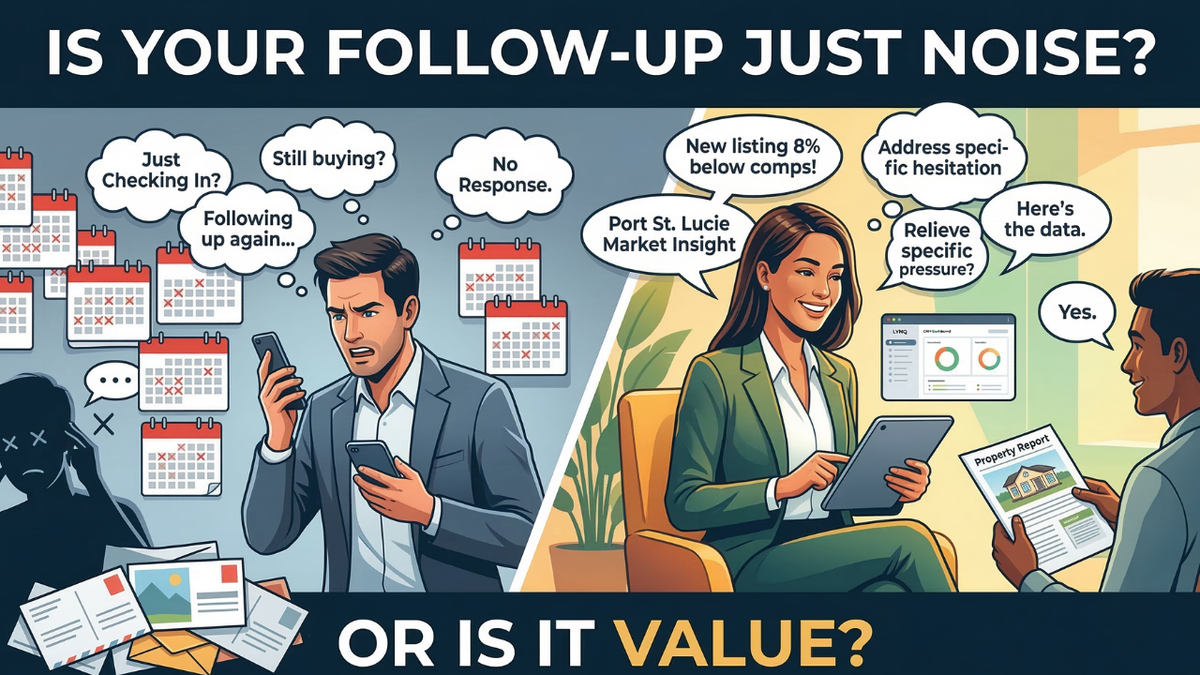
The volume of follow-up is rarely what's broken. What's broken is what happens — or doesn't happen — between contacts. Most agents are reaching out without a reason to reach out. They're checking in when they should be adding value. And the people they're calling can feel the difference.
This post isn't about working harder or making more calls. It's about building a contact structure that gives every follow-up a purpose. By the time you finish reading, you'll have a clear five-touch framework you can apply immediately to the leads sitting in your CRM right now.
Why "Follow Up More" Is the Wrong Answer
According to NAR research, the majority of buyers and sellers only interview one or two agents before choosing who to work with. That means the agent who gets there first — and stays present without becoming noise — wins a disproportionate share of business.
But "staying present" and "checking in repeatedly" are not the same thing.
When an agent sends a third "just following up" email with nothing new to say, they are not staying present. They are signaling that they don't have a system. And leads, without even being able to articulate why, start tuning them out.
The agents who understand why agents hit a ceiling at 5–10 deals are often the ones who recognize this early: volume doesn't solve a structural problem. A system does.
Here's the real dynamic: people don't ignore follow-up because they've lost interest. They ignore it because there's nothing in the message that warrants a response. When every touchpoint is a variation of "are you still thinking about buying?", you've given them no reason to engage. You've made the conversation about your need to know their timeline, not their need to take a useful next step.
The fix isn't more calls. It's a sequence designed around their journey.
What a Value-Adding Follow-Up System Actually Looks Like
A follow-up system isn't a script. It's a logic — a reason why each contact happens, what it delivers, and what response it's designed to earn.
Think about the difference between these two touchpoints:
Option A: "Hey, just checking in — are you still thinking about making a move this year?"
Option B: "I pulled three properties that just came on in [their target area]. Two are priced about 8% below the comps from two months ago. Wanted to make sure you saw these before they move. Want me to send the full details?"
Both are follow-up. One is a check-in. The other is a reason to respond.
The second message doesn't feel like sales. It feels like service. That's the distinction that separates agents who build pipeline from agents who exhaust it.
A real follow-up system is built around the question: what does this person need to know at this stage of their journey — and how do I deliver it in a way that makes the next step obvious?
That's not a script. That's a strategy.
The Five-Touch Sequence: What to Say at Each Stage
This is the framework. Not a rigid script — a contact logic that gives every touchpoint a job to do.
Touch 1 — Establish the Value Frame
Timing: Within 24–48 hours of first contact or lead capture.
This is not an introduction. That ship has sailed — they already know you reached out. This first touch is about establishing what kind of follow-up they should expect from you.
Something like: "I wanted to make sure you knew what I'd actually be sending your way. I don't do generic updates — I'll only reach out when I have something specific to your situation. If I go quiet, it means nothing relevant has hit the market. If I'm calling, it's worth picking up."
You're calibrating their expectations. You're telling them your follow-up will have a reason. That single move separates you from every other agent in their inbox.
Touch 2 — Deliver a Market-Specific Insight
Timing: 5–7 days after Touch 1.
This touch earns credibility. Send something specific — a price reduction in their target neighborhood, an absorption rate shift in their price range, a relevant comp that just closed. It doesn't have to be long. It has to be accurate and relevant.
"Wanted to flag that inventory in the $450K range in Port St. Lucie dropped 18% this month compared to last quarter. If you're still targeting that range, the window for negotiation is getting shorter. Worth a conversation when you're ready."
You're not asking for anything. You're demonstrating that you're watching the market on their behalf. That's what earns the next response.
Touch 3 — Address the Most Common Objection
Timing: 10–14 days in.
By this point, if they haven't engaged yet, something is keeping them back. Most of the time it's one of three things: timing uncertainty, financial uncertainty, or they're still deciding whether to use an agent at all.
This touch picks the most likely friction and addresses it directly — not defensively, but practically.
"A lot of people I talk to at this stage are working through the same question: is now actually the right time, or does it make more sense to wait? I put together a short breakdown of how that decision looks in today's Treasure Coast market. It's not a pitch — it's just the math. Want me to send it?"
You're naming their hesitation before they have to. That's a level of EQ that most agents skip entirely.
Touch 4 — Re-Engage With Something Personal
Timing: 21–28 days in.
This is where most follow-up sequences fall apart. Agents either go silent or keep sending the same kind of market update. Neither earns a response.
Touch 4 is different. It references something specific from your first conversation — their timeline, their situation, something they mentioned — and reconnects to it personally.
"You mentioned back in January you were waiting to see what happened with interest rates after Q1. Q1's essentially done — wanted to check in on where that sits for you now."
This demonstrates that you were listening. Not that you have them in a CRM workflow. That single distinction moves people from "another agent" to "the agent who pays attention."
Touch 5 — Offer the Clear Next Step
Timing: 30–45 days in.
If they haven't responded by now, this touch does one of two things: it re-engages them, or it gives them a clean exit. Both outcomes are useful.
"I've kept your search active and nothing has come up that I'd actually recommend. I'll keep watching, but if your situation has changed or you've decided to hold off, just let me know — I'll update my notes and reach back out when the market shifts in your direction. No pressure either way."
This is the most underestimated close in real estate. You're releasing pressure, which almost always creates a response. People feel safe enough to tell you where they actually are. And if they are still interested, this re-opens the conversation naturally.
If they don't respond to Touch 5, you don't stop following up — you shift to a lower-frequency long-nurture cadence. That's a separate system. But for active leads, the five-touch sequence gives you a defined, purposeful structure to work within.
Why This Works: The Psychology Behind Value-First Follow-Up
There's a reason this approach outperforms check-in calls. It's not magic — it's basic psychology.
When you turn your CRM into a business engine, you're not just organizing contacts. You're building a rhythm of communication that keeps you present without making people feel managed. The five-touch sequence does that because every contact is designed around their needs, not your urgency.
The "check-in" call puts the discomfort of the relationship squarely on the prospect. They have to decide whether to engage or politely deflect. It's a small friction, but it accumulates.
The value-touch flips the dynamic. Now the agent is the one doing the work. The prospect just has to decide whether the information is useful. That's a much lower bar. And every time they find it useful — even if they don't respond — you're depositing trust.
This also matters on the Treasure Coast specifically. The real estate market here is deeply relational. A significant portion of transactions come from people who relocated from out of state, often with no existing agent relationship. The agent who demonstrates the most market knowledge and the most genuine interest in their situation — not their commission — builds the kind of trust that converts.
LYNQ agents work through this exact system as part of their lead conversion training. It's not a hack. It's a shift in how you think about what follow-up is actually for.
What to Do With This
Here are five things you can do this week to implement this framework:
First, audit your current follow-up. Pull up the last ten leads you reached out to. What did you actually say? If the majority of your messages are variations of "just checking in," you're leaving conversions on the table regardless of how many times you called.
Second, write your Touch 1 message. Draft the value-frame opener for your current lead type — buyers, sellers, or both. Write it in your voice. The framework is the logic; the words should sound like you.
Third, identify two or three market insights you can have ready for Touch 2. Absorption rate, price per square foot movement, days on market trends for a specific zip code. You need real data points you can pull in under five minutes when the time comes.
Fourth, go back through your CRM and identify any lead you haven't contacted in 15–30 days. That's a Touch 4 candidate right now. Find the personal detail from your first conversation and write the message tonight.
Fifth, make Touch 5 a standing part of your process for any lead that hasn't responded after 30 days. The pressure-release close is underused. Use it. You'll be surprised how often it opens the door.
And if you want to automate parts of your follow-up sequence without losing the personal quality that makes it work, the AI workflows I covered in a recent post are a good starting point for building that infrastructure efficiently.
If you'd like to talk through your current follow-up approach — what's working, what's getting ignored, and where the gaps are — I'm happy to have that conversation. No agenda, just a genuine look at where you are. You can book a free 30-minute Growth Strategy Session at calendly.com/steve-lynqrealty/30min.
If you want the complete 5-Touch Follow-Up Sequence Template to build this out for your own pipeline, DM the word FOLLOWUP on Instagram. I'll send it straight to you.
Frequently Asked Questions
Q: Why isn't my real estate lead follow-up converting even though I'm calling consistently?
A: Consistent contact is only half of the equation. The other half is whether your follow-up gives the lead a reason to respond. Most agents default to check-in calls — "just following up to see where you are" — which puts the burden of engagement on the prospect. They have to decide whether to engage or deflect, and deflecting is easier. A follow-up system built around delivering relevant value at each stage — market insights, objection-addressing content, personal callbacks — removes that friction. Each contact earns a response rather than requesting one. If your volume is there but your conversions aren't, the content of your contacts is the variable to examine.
Q: How many times should a real estate agent follow up with a lead before moving on?
A: There's no universal number, but a structured five-touch sequence over 30–45 days gives an active lead sufficient opportunity to engage without being overwhelmed. After five purposeful, value-adding contacts with no response, most agents should shift the lead to a lower-frequency long-nurture cadence — monthly or quarterly touchpoints that keep you present without the intensity of active follow-up. Don't delete or abandon the lead. People's circumstances change. A lead that goes cold in March may be ready in September. The goal is to stay present without burning the relationship through over-contact.
Q: What should I say when following up with a real estate lead who hasn't responded to several messages?
A: After multiple touchpoints without a response, the most effective move is the pressure-release close: acknowledge that you've reached out a few times, confirm that you'll keep their search active, and explicitly give them permission to let you know if their situation has changed or they'd prefer to wait. Something like: "I've kept your search active — nothing I'd actually recommend has come up. If your situation has changed or you've decided to hold off, just let me know and I'll update my notes." This approach releases pressure, which almost always produces a response — either re-engagement or a clear update that lets you triage your pipeline accurately.
Q: What's the difference between a follow-up system and just following up more often?
A: Volume without structure is noise. A follow-up system is a defined logic — every contact has a specific purpose, delivers something of value to the prospect, and is designed to earn a particular response or move the relationship forward in a specific way. Following up more often without that logic means you're adding more contacts with less reason for each one. The result is diminishing returns: the more you reach out without purpose, the more conditioned the prospect becomes to ignore your messages. A system ensures that every touch builds trust rather than depleting it.
Q: How do I follow up with real estate leads without feeling pushy or salesy?
A: The feeling of being pushy comes from contacts that center your needs — your timeline, your commission, your urgency to know their decision. Follow-up that centers the prospect's situation never feels pushy because it isn't pushy. Ask yourself before each contact: am I delivering something useful to this person, or am I asking them for something? If you're flagging a price reduction in their target neighborhood, sending relevant market data, or addressing a concern they mentioned — that's service, not sales. The agents who feel most uncomfortable with follow-up are usually the ones whose contacts are built around their own urgency. Rebuild the contact logic around the prospect and the discomfort largely goes away.
Q: How do Treasure Coast real estate leads respond differently to follow-up compared to other markets?
A: The Treasure Coast market has a high proportion of out-of-state relocation buyers who are often navigating an unfamiliar market remotely. These leads tend to require more educational follow-up — market context, neighborhood comparisons, lifestyle information — before they're ready to act. They're less likely to respond to urgency-based follow-up and more likely to engage with agents who demonstrate genuine local expertise and patience. A value-first follow-up sequence works especially well here because it positions the agent as a resource rather than a salesperson, which is exactly what a relocation buyer from outside Florida needs. Steve Banasiak and the agents at LYNQ Real Estate build their follow-up systems specifically around this Treasure Coast buyer profile.
Q: What tools or CRM should a real estate agent use to manage a structured follow-up sequence?
A: The specific CRM matters less than whether you're actually using it consistently. Most agents have access to a CRM through their brokerage and underuse it. The key is building your five-touch sequence logic into the CRM as a task or workflow so that every lead has a next-contact date and a note on what type of contact that should be. If you're at LYNQ Real Estate, we walk through this setup as part of agent onboarding and coaching. For any agent, the minimum viable setup is a CRM that tracks lead source, last contact date, next contact date, and a short note on the lead's situation. Without those four fields populated and current, you don't have a follow-up system — you have a list.
Q: How do I write a follow-up message that actually gets a response from a real estate lead?
A: Three things make a follow-up message response-worthy. First, specificity — it references something particular to their situation, not a generic market update. Second, value — it delivers information or insight that is genuinely useful to them at this stage of their search. Third, a low-friction next step — it asks for something easy, not a commitment. "Want me to send you the full breakdown?" is easier to answer than "Are you ready to set up showings?" The messages that get ignored are the ones that skip all three. They're vague, they ask for something, and they give the prospect nothing in return. Flip that structure and your response rates will reflect it.
About Steve Banasiak
Steve Banasiak is the Broker-Owner of LYNQ Real Estate, a modern, coaching-first brokerage serving real estate agents across Florida's Treasure Coast — including Port St. Lucie, Stuart, Fort Pierce, and Vero Beach. A 2023 Treasure Coast Broker of the Year, Steve has spent his career helping agents build businesses that are scalable, sustainable, and genuinely theirs to own.
With a background in agent training and curriculum development, Steve has helped train and scale hundreds of new and experienced agents' businesses. He uniquely blends time-tested traditional real estate tactics with a modern and future-forward vision for how agents can work with more clarity, leverage, and intention.
Steve is the founder and team leader of LYNQ Real Estate, located at 1940 SW Fountainview Blvd, Suite 101, Port Saint Lucie, FL 34986. He writes "The Scalable Agent" — a coaching blog for Treasure Coast agents at every stage of their career.
If you are a real estate agent on the Treasure Coast looking for a brokerage that takes your growth seriously, you can learn more at getlynqed.com or book a free 30-minute Growth Strategy Session at calendly.com/steve-lynqrealty/30min.
Connect with Steve:
YouTube: youtube.com/@stevebanasiak
Instagram: instagram.com/steve_banasiak
LinkedIn: linkedin.com/in/stevenbanasiak
Facebook: facebook.com/StevenBanasiakBroker